The bargain
Shadow does not always look like shadow.
Long ago, we kept the parts of the Self that were welcomed and let go of what was not. What we let go of did not leave. It only stopped feeling like us.
When we reject parts of ourselves, it is as though we squirrel them away in a junk drawer and forget they are there. Yet without the light of awareness or the transforming presence of genuine relationship, these parts suffer in isolation. Their qualities may become more extreme. What was once merely unwelcome can grow darker.
Some shadow does not hide at all. We encounter something that disturbs us, frightens us, or appears dangerous. We name it easily. Usually in someone else.
Or shadow arrives attractively dressed, offering relief, prosperity, recognition, power, or an escape from hardship. It asks for something that appears small or distant—something we believe we can afford to lose. Only later do we discover what the bargain has truly cost.
This is how shadow first enters the story, The Handless Maiden.
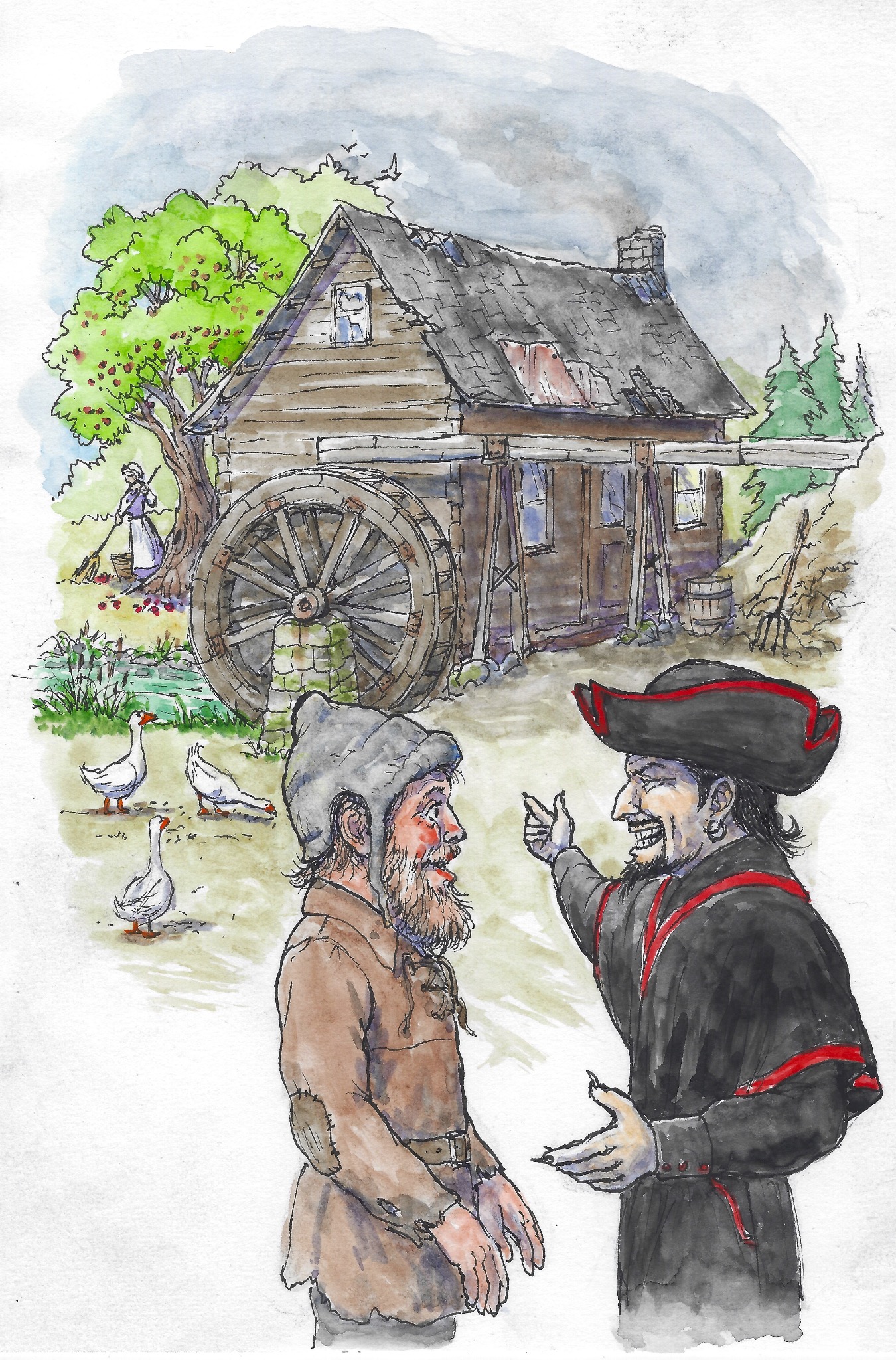
A poor miller encounters a handsome gentleman beside his broken-down mill. The stranger offers him wealth and comfort in exchange for whatever is standing behind the mill. Believing he is bargaining away an old apple tree, the miller agrees.
He does not recognize the devil standing before him. Nor does he realize that his beautiful daughter is sweeping the yard behind the mill.
He has bargained away his own child for a life of ease and luxury.
The miller’s wife recognizes the devil, yet their home is now filled with everything money can buy. Perhaps they hope the bargain will be forgotten.
In this story, the shadow returns to collect what it has been promised.Alongside the shadow
There is light.
In this story, the young maiden—the feminine energy living within each of us—carries that light. She is a good daughter who tries to please and obey her father. Yet when the devil comes to claim her, something deep within her refuses to surrender.
The maiden draws a boundary around herself.And she weeps.
Her boundary and her tears prevent the devil from taking her. Enraged, he threatens to destroy the family unless her father cuts off her hands. Her father acquiesces. The daughter who was first bargained away is now betrayed again.
But even without her hands, the devil cannot possess her.
The maiden understands that she can no longer remain in her parents’ home. Their newfound wealth cannot save her. She would rather become a beggar and enter the unknown than remain surrounded by riches in the place where she was betrayed. And so the Handless Maiden leaves home. A light guides her toward a royal orchard, where the trees shelter her and a pear tree bends down to feed her.
Another journey begins
Like Dorothy, she leaves home.
Like Dorothy, she has felt abandoned, unseen, and unprotected. She has learned to be a good girl—to please, obey, and adapt to what others expect of her—while something within her longs for more.
And like Dorothy, she does not make the journey alone. Others appear to guide her, shelter her, nourish her, and help her discover capacities she does not yet know she possesses.
But the Handless Maiden’s journey takes us into different terrain. She marries, receives silver hands, gives birth, and encounters the devil’s return. She is no longer only the abandoned daughter. She becomes a mother protecting her child—and learning to mother herself.
Dorothy’s journey reveals how love and power can be integrated within us as we reclaim our wholeness. The Handless Maiden carries that exploration into intimate partnership. Hers is a love story—not simply about finding love, but about how love matures within each partner and in the space between them.
Dorothy comes home to herself.
The Handless Maiden learns to become at home within herself—and then to create a home with another.
Take the journey with her ↓Developing an Inner Mother
From birth mother to therapeutic motherto becoming a mother—to true self-care and love.
Her birth mother recognizes the danger but cannot protect her.
Her mother-in-law recognizes the danger and actively protects her.
The maiden internalizes the protecting mother and becomes that presence for herself and her child.
The shadow limits her.
The light preserves and enlarges her.
Only when the maiden has grown her own hands—and the King has undertaken his own journey—can they meet again as equals. Their second marriage is not a rescue. It is the integration of love and power within each partner and in the living space between them.
Like Dorothy’s journey, the Handless Maiden’s tale is a journey of differentiation, dialogue, and integration. By the end of their stories, both women have reclaimed lost parts of themselves, discovered their power, and opened to a fuller experience of wholeness and love.
Travel Dorothy’s road →